
What Is 7-Hydroxymitragynine Addiction and Is It Dangerous?
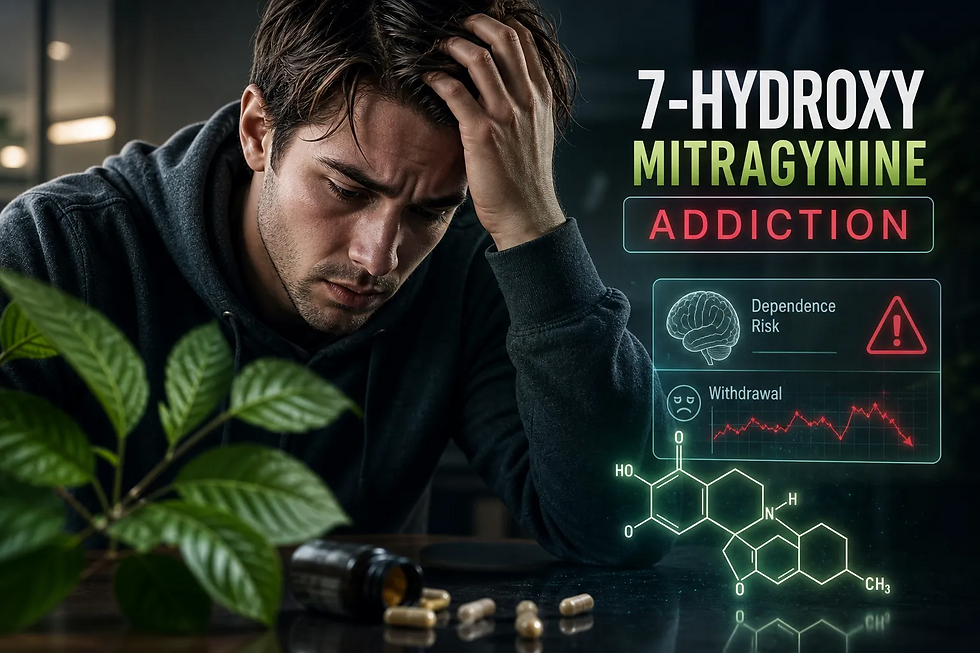
7 OH addiction, dependence on 7-hydroxymitragynine, is an emerging public health concern that most people have never heard of but may already be experiencing firsthand. In July 2026, the FDA sent warning letters to seven companies marketing products containing this compound. These products show up as gummies, tablets, drink shots, and kratom extracts sold at corner stores, gas stations, and online retailers. The agency acted because the safety signal had grown impossible to ignore: according to FDA warning letters and poison center surveillance data, hundreds of poison center calls, hospitalizations, and documented deaths have been tied to this substance, including 593 reported exposures in 2025 alone.
The core problem is a dangerous gap in awareness. People buying these products believe they're taking a natural supplement. What they're actually taking is a potent opioid-like compound that can produce dependence within days of regular use. If you've been using these products and something feels off, or if you're watching someone you care about change in ways you can't explain, that concern is worth taking seriously. At Decision Point Center in Prescott, Arizona, clinicians are increasingly seeing patients with emerging dependencies that don't fit familiar categories, and individualized assessment is always the starting point.
What 7-OH Actually Is and How It Differs from Regular Kratom
7-hydroxymitragynine is a naturally occurring alkaloid found in the kratom plant. It's also produced as a metabolite when the body breaks down mitragynine, the primary compound in traditional kratom leaf. The critical distinction is this: natural kratom leaf contains only trace amounts of 7-OH, whereas modern commercial products often use concentrated or synthesized 7-OH as a primary ingredient. Concentrated 7-OH products can have a markedly different, far more opioid-like pharmacological profile than traditional whole-leaf kratom, a shift that changes the risk picture entirely.
The potency gap is significant. Preclinical data and published pharmacological comparisons show that 7-OH is approximately 10 to 46 times more potent than mitragynine depending on the assay. In preclinical models, it is roughly 13 times more potent than morphine at the mu-opioid receptor and more than three times more potent than morphine at causing respiratory depression. When people hear "partial agonist at the mu-opioid receptor," that can sound technical and benign. The plain-language meaning is this: 7-OH activates the same brain pathway as heroin or oxycodone. The mechanism is slightly different, but the receptor is the same.
The product landscape made the problem worse. Tablets, gummies, sublingual films, and concentrated shots are now widely marketed as kratom extracts, and many users have shifted away from leaf-based powder without recognizing they've moved into a different substance category entirely. Someone who started with kratom powder years ago and recently switched to a "kratom extract" gummy may not realize those products deliver doses that make opioid-level 7 OH addiction far more likely, and far faster.
Why 7 OH Addiction Develops Faster Than Most People Expect
When 7-OH binds the mu-opioid receptor repeatedly, the brain responds by reducing its natural production of feel-good neurochemicals and down-regulating receptor sensitivity. This adaptation is the biological foundation of physical dependence, and it doesn't take months to happen. Because 7-OH is both highly potent and relatively short-acting, this neurological rewiring can occur within days to weeks of consistent use. Withdrawal symptoms can begin as soon as six to twenty-four hours after the last dose.
The "natural" label creates a genuinely dangerous blind spot, and that blind spot is one of the defining features of 7-hydroxymitragynine addiction. Many people using 7-OH products believe they are taking a supplement, not a substance that acts on the same receptor system as prescription opioids. That belief delays recognition of a problem by weeks or months. By the time someone realizes something is wrong, they may already be deep into a cycle of physical dependence.
Tolerance drives that cycle forward. The initial dose stops producing the desired effect, so the user increases the amount or the frequency. Before long, they're not using to feel good, they're using to avoid feeling sick. Needing to take something just to function normally is the signature pattern of opioid-type dependence, and it applies directly to 7 OH addiction. The substance dictates the schedule, not the person.
Signs That Use Has Crossed into 7-OH Dependence
Physical dependence has concrete, recognizable indicators. Needing a dose first thing in the morning just to start the day is one of the clearest. Other signs include muscle aches and stomach cramps when doses are late or missed, sweating between doses, disrupted sleep, and a noticeable drop in appetite. These are not coincidences or stress symptoms, they are signs the body now requires the substance to maintain baseline function. They deserve to be taken seriously, not rationalized away.
Behavioral patterns tell an equally clear story. Hiding use from family members, spending more money than intended on products, failed attempts to cut back, and continuing to use despite noticing the impact on work or relationships all signal a loss of control. Thinking about the next dose throughout the day is a behavioral sign that the substance has reorganized a person's priorities. If you notice several of these patterns together, a clinical evaluation is the appropriate next step.
What Family Members May Notice
For family members watching from the outside, the signs look different but are just as significant. Unexplained mood swings, withdrawal from social activities, frequent online orders of kratom or supplement products, and irritability that resolves shortly after the person takes something are all worth paying attention to. These changes deserve a conversation, not a confrontation, and not silence either.
What 7-OH Withdrawal Looks and Feels Like
For someone with physical dependence, 7oh withdrawal symptoms can begin within hours of a missed dose or significant dose reduction. Early symptoms include restlessness, anxiety, muscle tension, irritability, and the beginning of stomach cramping. Many people redose at this point without recognizing it as withdrawal, they just know they feel better after taking something. That pattern reinforces the dependence cycle without the person ever naming what's happening.
Days one through three are typically the most intense. Muscle aches, cold sweats and chills, nausea and vomiting, diarrhea, insomnia, and strong cravings characterize the peak phase. Physical symptoms usually begin to ease by day five to seven, but sleep disruption, low mood, and cravings can persist for two to four weeks or longer in heavier users. Co-occurring anxiety and depression are common, and withdrawal tends to amplify both.
Some symptoms require emergency care, not a wait-and-see approach. Difficulty breathing, loss of consciousness, severe confusion, a racing or irregular heartbeat, and seizures are not standard withdrawal symptoms, they are medical emergencies. Poison center surveillance data cited in FDA communications found that among people exposed to 7-OH alone, 35% experienced serious health problems and 67% were treated at a healthcare facility. If these symptoms appear, call 911 first.
What U.S. Health Agencies Are Saying Right Now
The FDA's July 2026 enforcement actions marked a clear shift from observation to intervention. Seven companies received warning letters for illegally marketing 7-OH products including tablets, gummies, drink mixes, and shots. According to the FDA press release and warning letters published that month, the companies named included Shaman Botanicals, My Smoke Wholesale, Hydroxie LLC, and 7Tabz Retail, among others. Earlier enforcement included the seizure of approximately 73,000 units from firms in Missouri, with the products classified as adulterated. These aren't regulatory warnings issued out of an abundance of caution, they reflect documented harm.
The FDA's legal position is unambiguous, as stated in its warning letters: 7-OH is not lawful in dietary supplements and cannot be legally added to conventional foods. There are no FDA-approved products containing 7-OH. Products being sold in smoke shops, gas stations, and online stores are operating outside the law with no regulatory safety net protecting consumers. Poison center call volumes underscore the urgency: 593 exposures were reported in 2025, with 901 calls logged in just the first six months of 2026, according to national poison center surveillance data.
State and local authorities have moved alongside the FDA. The Virginia Department of Health posted guidance reinforcing the federal position, and Los Angeles County public health urged retailers to immediately remove illegal 7-OH products from shelves. For consumers, the practical reality is this: no third-party quality control, no verified dosing, and no regulatory protection apply to any product in this category currently on the market.
What Getting Help for 7 OH Addiction Actually Looks Like
Stopping cold turkey is not the safest path for someone with significant 7-OH dependence. Because this substance acts on opioid receptors, unsupervised withdrawal carries real medical risk, particularly for anyone using high doses, using for an extended period, or using alongside alcohol or other substances. Medical supervision during detox allows clinicians to monitor vital signs, manage severe symptoms, and intervene quickly if complications develop. The goal is not just making withdrawal more comfortable; it's making it safer.
Buprenorphine and buprenorphine-naloxone (Suboxone) are the best-documented medication options in published case reports and clinical series for kratom and 7-OH dependence. A 2025 case series documenting nine patients who used purified 7-OH products found successful stabilization in nearly 89% of cases using either standard or low-dose induction approaches. Clonidine and other symptom-management medications are commonly used alongside buprenorphine during the acute withdrawal phase.
There is no FDA-approved protocol specific to 7-OH dependence, which is exactly why individualized clinical assessment matters more than any one-size-fits-all approach. Knowing what to look for in a treatment facility makes a real difference: a licensed clinical team, a thorough intake assessment that asks about all substances (including novel ones like 7-OH), and a medical detox program that can be adapted to emerging dependencies are the non-negotiables.
How Decision Point Center Approaches 7-OH Treatment
At Decision Point Center in Prescott, Arizona, the intake process is built around each patient's specific substance history, not a generic protocol designed for a different era. The program includes individualized assessment, medically supervised detox, behavioral counseling, and dual diagnosis support for co-occurring anxiety and depression, because dependence rarely arrives alone.
Taking the Next Step
7 OH addiction is a real opioid-type condition. It develops faster than most people expect and carries genuine risks now documented across case reports, poison center data, and federal enforcement actions. The "natural supplement" framing surrounding these products is not a reflection of their pharmacological reality. A compound that is roughly 13 times more potent than morphine at the mu-opioid receptor is not a supplement in any meaningful clinical sense.
Help exists, and it works. Medical detox, buprenorphine-based medication support, and behavioral counseling have all been used successfully with people recovering from 7-hydroxymitragynine addiction. The fact that this substance is newer does not mean clinicians are unprepared. If any of the warning signs in this article felt familiar, a conversation with a treatment professional is the right next move. Recovery starts with an honest clinical picture, and that picture starts with a single phone call.


Comments