
Kratom Addiction: Is It Real and Do You Need Treatment?
Kratom addiction doesn't look like what most people picture when they imagine a substance use problem. There's no prescription pad, no back-alley transaction. The product is often sold alongside energy drinks and dietary supplements, labeled as a botanical product, priced like a vitamin. Many people using it every day genuinely don't think of it as a drug, let alone an addiction, and that's precisely why kratom dependence is so easy to miss until stopping becomes a crisis.
The reality is that the line between relief and reliance tends to dissolve quietly. A person starts using kratom for chronic pain, anxiety, fatigue, or to ease opioid withdrawal. It works. They keep using it. Months pass, doses increase, and one day they try to stop and discover their body has other plans. That experience is not a character flaw. It's the biology of dependence, and it happens to thoughtful, functional people who never set out to develop an addiction.
This article breaks down what kratom actually is and how dependence forms at a neurological level. It also covers what withdrawal genuinely feels like, the safety risks that rarely get discussed, and what evidence-based treatment looks like. If kratom use has stopped feeling like a choice, the information below is worth reading carefully.
What kratom actually is and why it affects the brain like an opioid
The plant, the products, and what's really inside them
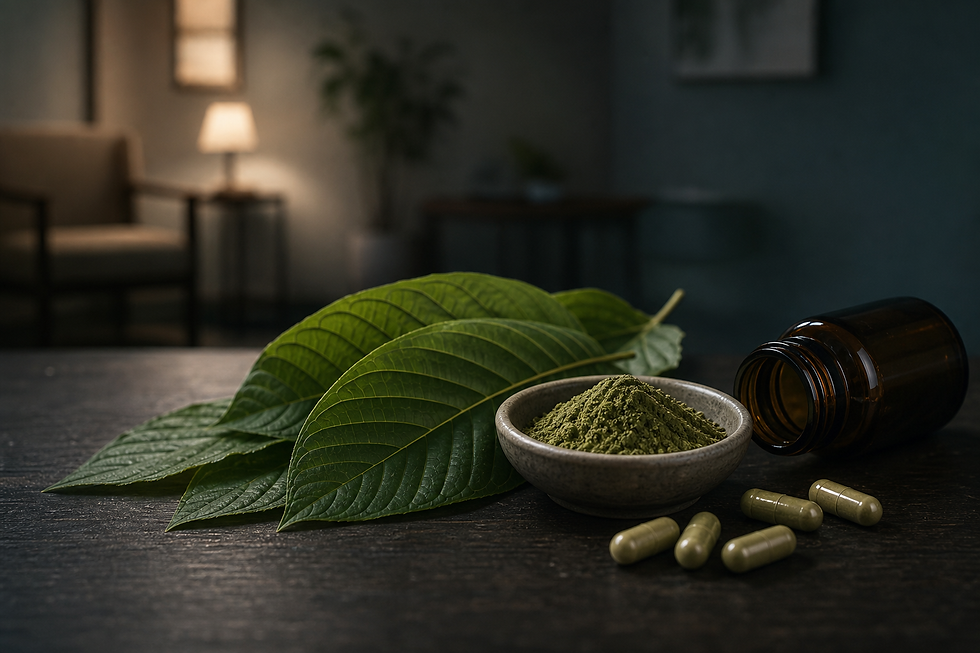
Kratom comes from Mitragyna speciosa, a tree native to Southeast Asia whose leaves contain psychoactive alkaloids. In the U.S. market, those leaves are dried and sold as powder, capsules, teas, and concentrated liquid extracts, with a wide range of potencies. A mild loose-leaf tea is a fundamentally different product from a high-concentration "enhanced" extract shot, even though both are sold legally and often display very similar labels.
None of these products are FDA-approved, and none are regulated as drugs. There is no standardized dose, no verified purity, and no requirement for manufacturers to disclose actual alkaloid content. What's on the label and what's in the product are not always the same thing, which matters considerably when you're talking about a substance that activates opioid receptors.
How mitragynine and 7-hydroxymitragynine work in the body
At low doses, kratom produces stimulant-like effects: increased energy, heightened alertness, improved mood. At higher doses, it activates the mu-opioid receptors, the same receptors targeted by prescription painkillers and heroin. The key driver of those opioid-like effects is a metabolite called 7-hydroxymitragynine (7-OH), which binds to opioid receptors with roughly 13 times the potency of morphine in preclinical assays. Concentrated synthetic 7-OH products, which have entered U.S. markets and been detected in poison center reports, carry respiratory depression risks more than three times greater than morphine at equivalent doses, according to FDA regulatory assessments.
This receptor activity explains why kratom is effective at relieving opioid withdrawal symptoms in some users. It also explains exactly why the brain begins to depend on it with repeated exposure. When you repeatedly activate opioid receptors with an external substance, the brain adjusts its chemistry accordingly, and eventually it needs that substance just to feel baseline normal.
How kratom dependence develops faster than most people expect
The gradual shift from relief to reliance
Most people who develop a dependence on kratom didn't start with recreational intent. They were managing something: chronic pain that wasn't adequately addressed, anxiety that interfered with daily life, opioid withdrawal they were trying to handle quietly, or persistent low energy. Kratom provided genuine relief, and that relief is real, which is part of why continued use feels justified for so long.
With daily use, the brain adapts to the presence of kratom alkaloids. Tolerance builds, meaning it takes more to achieve the same effect. Users find themselves taking higher doses more frequently without consciously planning to. Many describe noticing they've doubled or tripled their intake over a period of months without any single dramatic escalation. That gradual drift is a clinical hallmark of opioid-type dependence, not a personal failing.
What kratom use disorder actually looks like by clinical criteria
Clinicians assess kratom dependence using the same 11 DSM-5 substance use disorder criteria applied to alcohol, opioids, and other drugs. Two or more criteria over a 12-month period meets the threshold for a diagnosis. Across multiple surveys and prevalence studies using varying methodologies, somewhere between 25% and 63% of regular kratom users meet lifetime criteria for a substance use disorder, with the most commonly reported symptoms being withdrawal upon stopping, intense cravings, tolerance, and using more than intended.
The majority of cases fall in the mild-to-moderate range, which is one reason so many people never identify what they're experiencing as a disorder. Severe disruption to work and relationships, the kind that's harder to ignore, is less common with kratom than with other substances. But mild and moderate still mean real dependence, real withdrawal, and real difficulty stopping without support. Kratom addiction at any severity level deserves the same clinical attention as other substance use disorders.
Kratom withdrawal: what it feels like and how long it lasts
The physical side of stopping
Physical withdrawal from kratom mirrors opioid withdrawal closely. The most commonly reported symptoms include severe muscle and joint pain, sweating, chills, nausea, vomiting, diarrhea, runny nose, and significant insomnia. For many people, the gastrointestinal distress and sleep disruption are the most debilitating elements, and they're the ones most likely to drive someone back to using just to feel functional again.
Based on aggregated clinical case series, symptoms typically begin 6 to 24 hours after the last dose, intensify through days two and three, and peak around day four before beginning to ease. Most physical symptoms resolve by days five to seven. For heavy daily users, that acute window can be genuinely difficult to get through without some form of support, particularly when each day without kratom also brings significant discomfort.
The psychological symptoms that tend to linger
The physical symptoms are uncomfortable, but the psychological dimension is what drives most relapse. Anxiety, depression, intense cravings, irritability, and difficulty concentrating often outlast the physical symptoms by days or even weeks. The body starts feeling better, but mood stays flat, motivation stays low, and the pull toward kratom to fix that flatness remains strong.
Post-acute psychological effects, including fatigue, cognitive fog, and cravings triggered by stress, can persist for weeks to months after the acute phase resolves. Anyone experiencing this pattern after reducing or stopping use should recognize it as a clinical withdrawal response, not evidence that they're incapable of recovery.
The safety risks that make kratom more dangerous over time
Overdose risk and rising hospitalizations
The "natural" framing around kratom is one of its most misleading marketing claims. As noted above, concentrated 7-OH products carry respiratory depression risks more than three times greater than morphine and have been linked to confirmed fatal overdoses in otherwise healthy adults, including six documented deaths in Los Angeles County from a single outbreak involving concentrated synthetic 7-OH, according to regulatory reports. Poison center data from the National Poison Data System shows kratom-related hospitalizations have risen dramatically, from 43 single-substance cases in 2015 to 538 in 2025, a more than tenfold increase.
Regular kratom use has also been associated with liver toxicity, with documented cases of acute hepatitis and, in rare cases, liver failure. Because kratom products are unregulated, contamination with heavy metals, bacteria, and undisclosed drugs adds another layer of risk that users rarely account for. Studies analyzing alkaloid content across commercial kratom products have documented significant batch-to-batch variability, meaning a product that seemed tolerable for months may contain substantially different concentrations in the very next batch.
Combining kratom with alcohol, opioids, or benzodiazepines compounds the respiratory depression risk significantly. Avoid combining kratom with any of these substances, since kratom's pharmacology is not fully characterized and interactions with prescription medications remain difficult to predict from label information alone. This isn't theoretical risk: 35% of patients with confirmed 7-OH exposure required serious medical intervention, and 67% were treated at a healthcare facility.
Does kratom addiction require professional treatment?
When stopping on your own isn't enough
Many people attempt to stop kratom without outside help and cycle through withdrawal before returning to use just to feel normal again. This cycle is not a motivation problem. It's how physical dependence on opioid-receptor-active substances works. The brain has reorganized itself around the presence of kratom alkaloids, and that reorganization doesn't undo itself in a week of discomfort.
For moderate-to-severe kratom dependence, medically supervised withdrawal management significantly reduces discomfort during the acute phase and lowers relapse risk. Professional treatment becomes especially important when kratom use overlaps with other substance use, a mental health diagnosis, or a prior history of opioid use disorder. Any one of those factors increases the complexity of withdrawal and the need for individualized clinical support.
Treating kratom addiction: evidence-based options
Off-label buprenorphine, most commonly formulated as buprenorphine-naloxone, has the most documented clinical support for managing kratom withdrawal and reducing cravings, based on published case reports and small case series. While no randomized controlled trials specific to kratom use disorder currently exist, the case series literature consistently shows buprenorphine effectively stabilizes opioid receptors, reduces withdrawal severity, and supports sustained abstinence. Induction can begin as early as eight hours after the last kratom dose, and maintenance typically runs at 8 to 24 mg daily depending on individual needs.
Behavioral therapies are essential alongside medication. Cognitive behavioral therapy helps identify the triggers and thought patterns driving use. Contingency management programs have shown effectiveness in kratom-specific case studies. Group therapy provides accountability and community during the period when motivation is most vulnerable. Each component addresses a different dimension of kratom addiction recovery, and the combination is what produces durable outcomes.
Levels of care mirror opioid use disorder treatment: medical detox for acute stabilization, residential inpatient for complex or severe cases, and Intensive Outpatient Programs (IOP) for step-down care or less severe dependence. Choosing the right level depends on dependence severity, co-occurring conditions, and individual circumstances, which is why a thorough clinical assessment matters before a treatment plan is built.
Why individualized assessment is the non-negotiable first step
Kratom addiction remains unfamiliar to many clinicians. A general practitioner may not recognize withdrawal symptoms as kratom-related, or may not know to ask about kratom use during an intake. A comprehensive assessment that captures the full substance use history, including kratom, is what separates a treatment plan that actually works from one that misses the central issue entirely.
At Decision Point Center in Prescott, Arizona, clinical intake covers substance use history, medical background, mental health, and life circumstances. That process includes less commonly discussed dependencies like kratom addiction, where thorough assessment is especially critical given how often the condition goes unrecognized. The goal is to understand what drove the use in the first place, identify any co-occurring conditions, and build a genuinely individualized plan. That's what distinguishes whole-person treatment from a generic protocol applied uniformly regardless of the individual's actual picture.
Taking the first step toward kratom addiction help
If you're reaching out to a doctor or treatment center about kratom use, the most useful thing you can do is be specific. How much are you taking, how often, and for how long? What other substances or medications are involved? What mental health symptoms have you been managing? The fuller the picture a clinical team gets, the more accurately they can assess withdrawal risk and recommend the right level of care.
A quality intake assessment won't feel like an interrogation. It's information gathering designed to match you to an appropriate starting point, whether that's medical detox, residential treatment, or outpatient programming. From there, the work moves beyond getting through withdrawal and toward understanding what the kratom was doing for you and how to address those underlying needs through sustainable means.
Kratom addiction is real. It meets clinical diagnostic criteria, it produces genuine physical and psychological dependence, and it responds to real treatment. The hesitation to reach out is understandable, particularly when the substance was legal, marketed as natural, and started as a solution to a legitimate problem. But asking for a clinical assessment isn't an admission of failure; it's the same kind of decision you'd make for any other medical condition that wasn't resolving on its own. If kratom use has stopped feeling like a choice, that's precisely the moment when professional support becomes the most rational next move.



Comments